
 Chinese
 English
Service Hotline
+86 18948275773+86 13632667260




Rolling thick walled nickel titanium alloy pipes is a complex process that requires precise control of process parameters and equipment operation. Here are some key information about the rolling of thick walled nickel titanium alloy pipes:
1、 Rolling process:
Preparation of tube blank: Firstly, nickel titanium memory alloy tube blank is prepared by machining or hot processing. The size of the tube blank can be calculated based on the actual cold processing deformation required for use.
Cold rolling: Three roll cold rolling technology is used to roll the tube blank to an inner diameter of 3-8mm, with a pass processing rate controlled at 10% -25%. After every 2 rounds of rolling, intermediate annealing should be carried out at a temperature of 500-700 ℃ for 0.5-1.5 hours to eliminate work hardening and restore the plasticity of the material.
Spinning forging: Cold rolled pipes are kept at 700-900 ℃ for 20-40 minutes, and then processed by spinning forging. The deformation of each pass does not exceed 30%, so that the inner diameter reaches the final size.
Pulling: By pulling, the outer diameter is machined to the desired size while ensuring that the inner diameter reaches the appropriate size, with a deformation of 5% -15% per pass.
Straightening and polishing: Finally, the finished thick walled pipe is obtained through straightening and outer circular grinding.
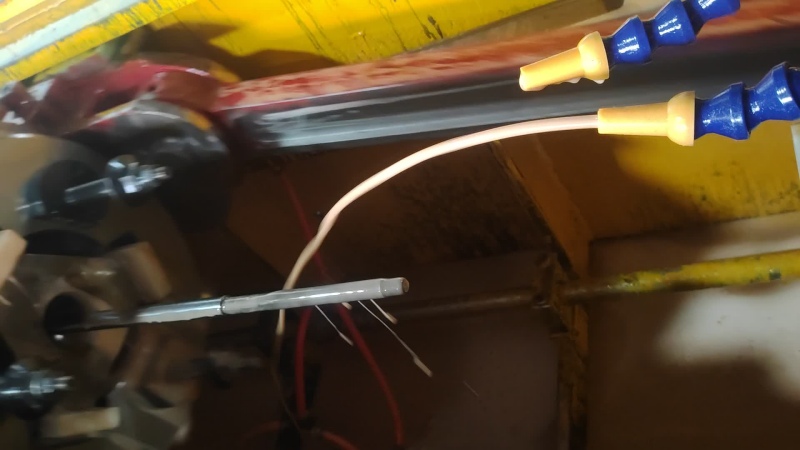
In the rolling of thick walled nickel titanium alloy pipes
2、 Equipment selection:
Cold rolling equipment: The three roll cold rolling mill is one of the commonly used equipment, which can provide more uniform rolling force and help control the accuracy of the inner diameter and wall thickness dimensions of the pipe.
Rotary forging equipment: The rotary forging machine uses multiple hammer heads to quickly and synchronously forge pipes, effectively reducing the inner diameter of pipes and improving their dimensional accuracy and surface quality.
Pulling equipment: Pulling machines are used to further adjust the outer diameter and wall thickness of pipes, usually requiring appropriate molds and tensile force control systems.
3、 Process parameter control:
Temperature control: Temperature control is crucial during the rolling process. For example, the intermediate annealing temperature and time during cold rolling, as well as the preheating temperature and holding time before rotary forging, can all affect the microstructure and properties of the pipe.
Control of pass deformation: Reasonable control of pass deformation can avoid defects such as cracks and fractures in the rolling process of pipes, and also help to obtain good microstructure and properties.
Speed control: The rolling speed will affect the surface quality and dimensional accuracy of the pipe, and needs to be adjusted according to specific process requirements and equipment performance.
Nickel titanium alloy pipes are mainly used in the medical field due to their core characteristics such as shape memory effect, superelasticity, and biocompatibility. At the same time, they also have specific applications in some industrial fields, as follows:
1. Medical field
This is the most important and mature application scenario for nickel titanium alloy pipes, especially indispensable in interventional medical devices, mainly including:
Cardiovascular intervention devices: used for the treatment of coronary heart disease, vascular stenosis and other diseases, such as coronary artery stents (nickel titanium tube processed into a mesh stent, implanted to restore the preset shape through body temperature, supporting blood vessels), and vascular embolization coils (used to treat aneurysms, adapting to vascular morphology with super elasticity).
Orthopedic and dental instruments: such as orthopedic correction nails, archwires (using shape memory effect to achieve progressive correction of teeth/bones), and vertebral body expansion balloon catheters (used to treat osteoporotic vertebral compression fractures, the balloon made of tubing can expand and support the vertebral body).
Endoscopy and minimally invasive surgical instruments: such as biopsy forceps for gastroscopy/colonoscopy, flexible rods for laparoscopic surgical instruments (using super elasticity to ensure flexible bending of the instrument in the body while maintaining structural strength).
Other medical uses, such as hemostatic clips, drainage tube stents, etc., all rely on their biocompatibility and shape stability.
2. Industry and other fields
In the aerospace field, such as pipeline connection joints (which automatically seal when temperature changes to avoid leakage), and support pipes for satellite deployment mechanisms (which contract during launch and return to their preset shape after entering orbit).
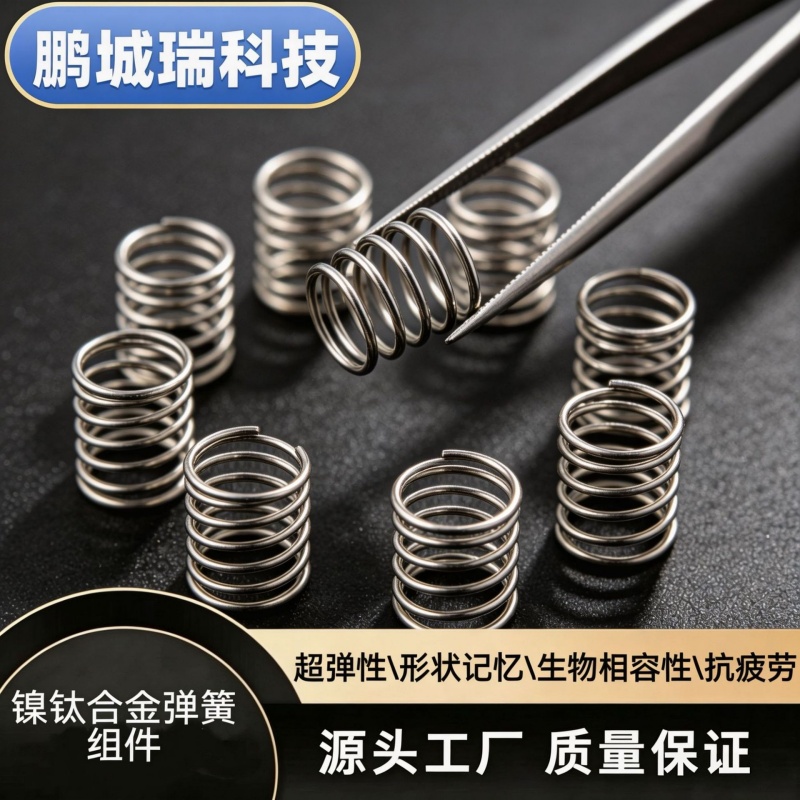
In the field of machinery and automation, such as temperature controlled valves (temperature triggered shape changes to achieve automatic opening and closing), precision springs (super elasticity makes their fatigue life much higher than traditional metal springs).
In the field of consumer electronics, such as the nose bridge/temple tube of some high-end eyeglass frames (super elastic to avoid deformation or breakage), and flexible structural components of smart wearable devices.
Nitinol
Seamless nickel titanium tube Nickel titanium fiber wire Nickel titanium plateApplication Area
Medical Industry New Energy Aerospace Machinery Manufacturing Marine Engineering Petrochemical IndustryContact Us
Contacts:Manager Wu +86 13632667260


 WeChat
 Call me
X