
 Chinese
 English
Service Hotline
+86 18948275773+86 13632667260




Factors affecting the dimensional accuracy of ultra-thin nickel-titanium alloy tubes span the entire process, including raw materials, processing techniques, post-treatment, and environmental control. Due to the shape memory effect and superelastic properties inherent to nickel-titanium alloy, controlling its dimensional accuracy is significantly more challenging than for ordinary metal tubes. Specific factors are as follows:
1. Raw material and billet factors
Uniformity of billet dimensions: As the foundation of tube processing, hollow cast billets or solid rod billets with large deviations in outer diameter and inner diameter, or uneven wall thickness issues, will directly magnify errors in subsequent rolling and drawing processes, ultimately leading to a decrease in the dimensional accuracy of the finished tube products.
Alloy composition uniformity: Slight fluctuations in the atomic ratio of nickel and titanium in nickel-titanium alloys can alter the alloy's phase transition temperature and mechanical properties. Segregation areas of composition are prone to uneven deformation during processing, which can lead to local deviations in wall thickness and outer diameter.
2. Forming process factors
Drawing process parameters: Drawing is the core process of ultra-thin-walled tube forming. The cone angle of the die, the length of the sizing belt, as well as the drawing speed and drawing force, all directly affect the dimensions of the tube. For example, excessive drawing force can easily lead to excessive shrinkage of the outer diameter of the tube, and wear of the die sizing belt can cause fluctuations in the outer diameter dimensions; whereas ultra-thin-walled tubes are more prone to problems such as "necking" or uneven local wall thickness thinning due to their extremely thin wall thickness during drawing.
Rolling process control: During the cold rolling or warm rolling process, the accuracy of the roll gap, the matching degree of the rotational speed, and the distribution of rolling passes determine the uniformity of the wall thickness and outer diameter of the tube material. Even a micron-level deviation in roll gap can lead to significant differences in the wall thickness of the finished product.
Welding quality (for welded tubes): Some large-diameter ultra-thin nickel-titanium tubes are formed using welding processes. The flatness of the weld seam and the distribution of welding stress can affect the roundness and wall thickness uniformity of the tube material. Uneven heat input during welding may also cause changes in the alloy microstructure in local areas, leading to inconsistent deformation during subsequent processing.
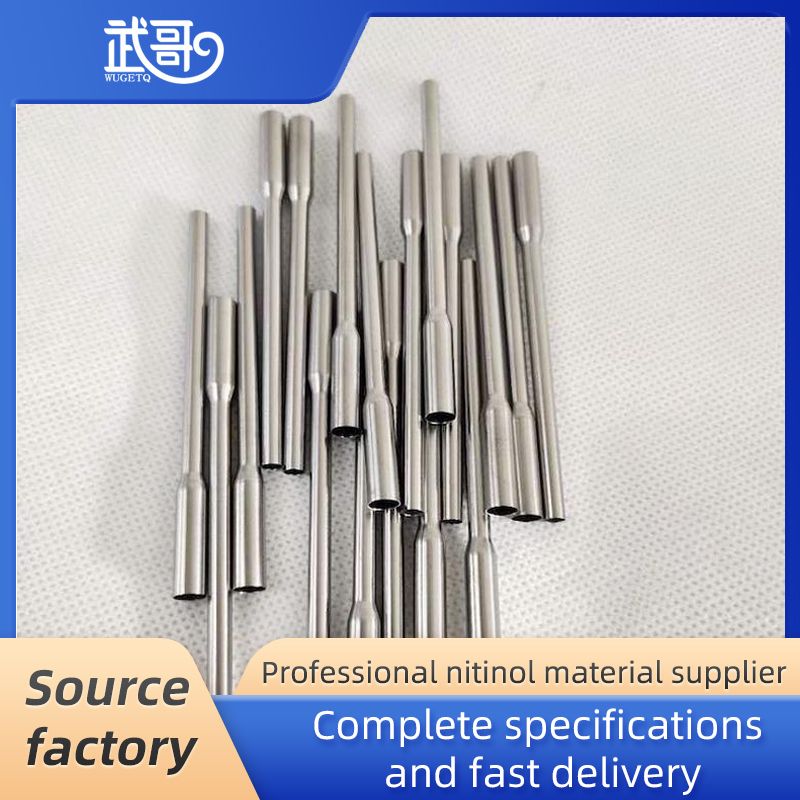
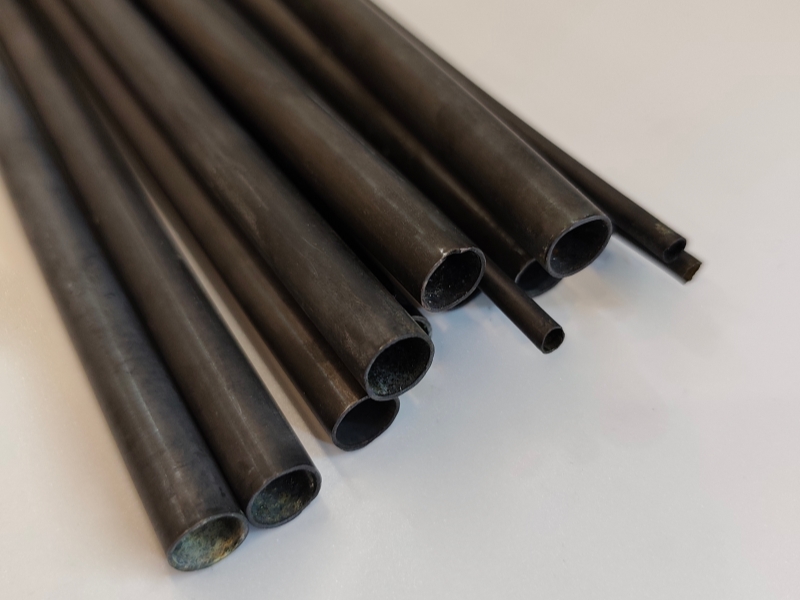
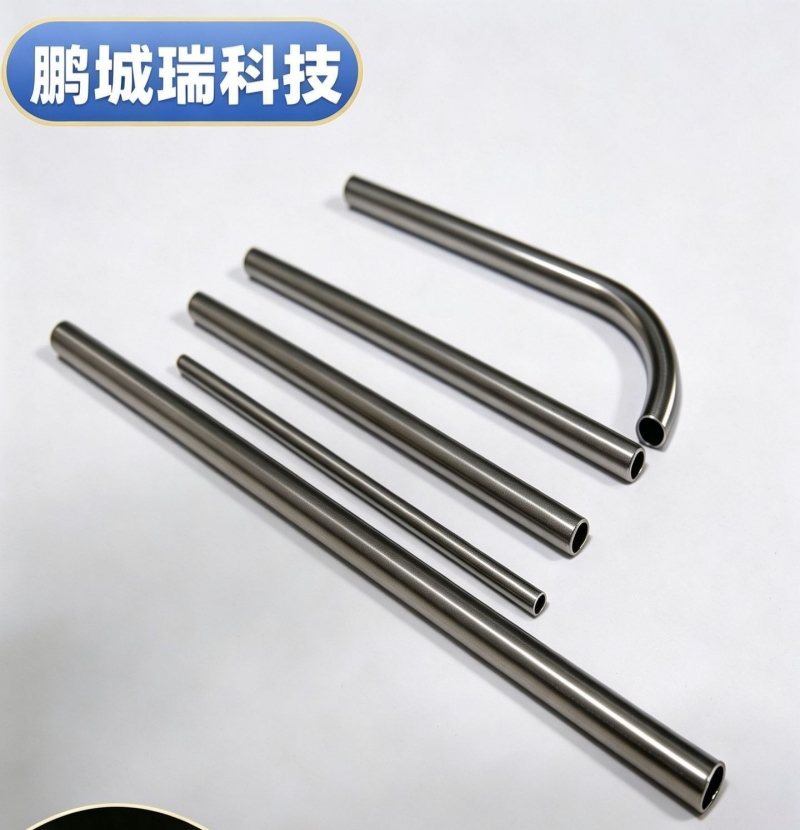
Ultra-thin wall nickel-titanium alloy tube
3. Heat treatment process factors
After forming, nickel-titanium alloy tubes require heat treatments such as solution treatment and aging to obtain shape memory or superelastic properties. Fluctuations in heat treatment temperature, holding time, and cooling rate can lead to varying degrees of lattice contraction or expansion in the alloy, thereby altering the outer diameter and wall thickness dimensions of the tube. Additionally, improper clamping during heat treatment can cause deformations such as bending and ovalization of the tube due to thermal stress, affecting dimensional accuracy.
4. Post-processing and finishing factors
Cutting and straightening: Ultra-thin-walled tubes have poor rigidity, and burrs and dimensional deviations are easily generated at the ends due to tool vibration during cutting. Improper pressure control during the straightening process can cause local wall thickness thinning or outer diameter deformation.
Polishing and cleaning: Medical-grade tubing requires high-precision polishing. Excessively large particle size of the polishing medium or excessive polishing pressure can lead to excessive wear on the surface of the tubing, resulting in minor deviations in wall thickness and outer diameter.
5. Environmental factors
Temperature fluctuation: The thermal expansion coefficient of nickel-titanium alloy is higher than that of ordinary metals, and changes in processing environment temperature can cause real-time dimensional fluctuations in the tubing. Especially in precision machining processes, deviations in room temperature exceeding ±2℃ may affect the final dimensional accuracy.
Vibration interference: The operational vibration of equipment such as drawing and rolling machines can disrupt the stability of the processing process, leading to a deviation in the relative position of the mold and the tube material, and resulting in dimensional errors.
Nitinol
Seamless nickel titanium tube Nickel titanium fiber wire Nickel titanium plateApplication Area
Medical Industry New Energy Aerospace Machinery Manufacturing Marine Engineering Petrochemical IndustryContact Us
Contacts:Manager Wu +86 13632667260


 WeChat
 Call me
X