
 Chinese
 English
Service Hotline
+86 18948275773+86 13632667260



The manufacturing process of nickel-titanium ropes (nickel-titanium alloy ropes) requires a combination of the shape memory effect and superelastic properties of nickel-titanium alloy, while also considering the uniformity, strength, and surface quality of the wire. The core process is divided into five major steps: raw material preparation, wire drawing, braiding and forming, heat treatment and finalizing, and post-treatment. The specific steps are as follows:
1. Preparation of raw materials: melting of nickel-titanium alloy ingots
1. Batching and melting
Accurately proportion the ingredients according to the nickel-titanium atomic ratio of 50.5% to 51.5% Ti and the balance being Ni (the ratio directly determines the phase transition temperature and properties of the alloy). Adopt vacuum induction melting or vacuum arc melting processes to melt pure nickel and pure titanium in a high vacuum environment, avoiding oxidation and impurity contamination.
After melting, the ingot needs to undergo homogenization annealing (temperature 900~1000℃, holding time 4~8h) to eliminate composition segregation and ensure uniform alloy microstructure.
2. Ingot breaking and cogging
The annealed ingot is rolled into a nickel-titanium alloy rod with a diameter of 8~15mm through forging or hot rolling process, preparing for subsequent drawing. This step requires strict control of the deformation temperature (about 700~800℃) to prevent brittle fracture of the alloy.
II. Drawing of nickel-titanium alloy wire: preparation of monofilament
Nickel-titanium ropes are woven from multiple strands of nickel-titanium monofilaments, and the diameter and properties of the monofilaments directly affect the quality of the rope. The drawing process is divided into two steps: hot drawing and cold drawing:
1. Hot drawing
Heat the bar material to 600~700℃, and gradually draw it into a thick wire with a diameter of 1~3mm through a series of carbide molds with decreasing pore sizes. The deformation amount per pass should be controlled at 10%~15% to avoid wire cracking.
2. Cold drawing and intermediate annealing
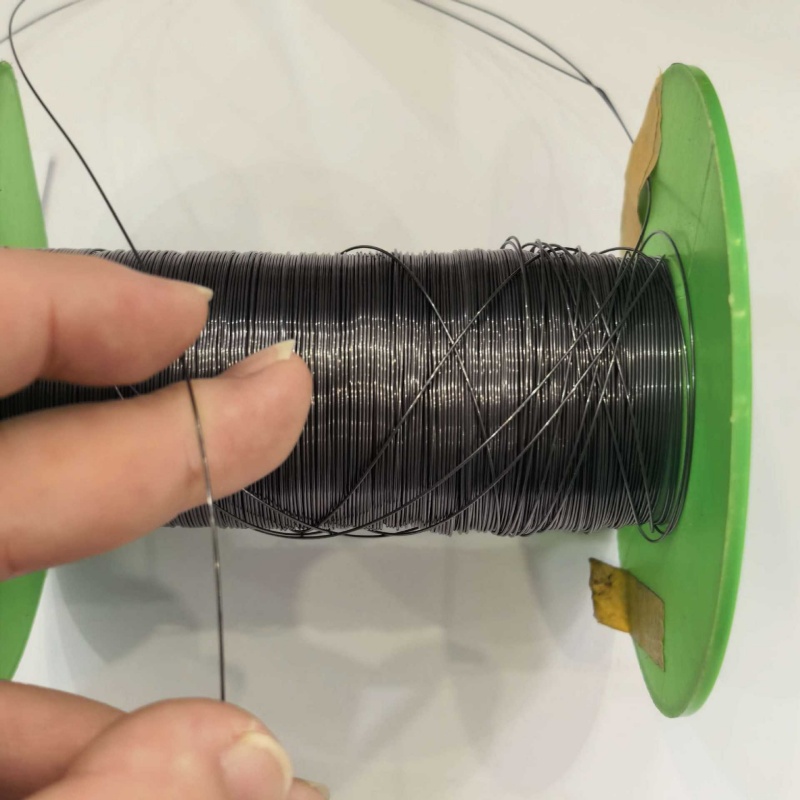
After removing the surface oxide layer through acid pickling, the thick wire rod undergoes cold drawing, passing through a die with a smaller aperture to be drawn into a thin single wire of the desired diameter (typically 0.1~1.0mm in diameter).
During the cold drawing process, the alloy undergoes work hardening, necessitating intermediate annealing (at a temperature of 400~500℃, with a holding time of 30~60min) to restore the material's plasticity and ensure smooth progress in subsequent drawing.
The final drawn monofilament must meet the requirements of a diameter tolerance of ±0.005mm, and the surface must be free of scratches and burrs.
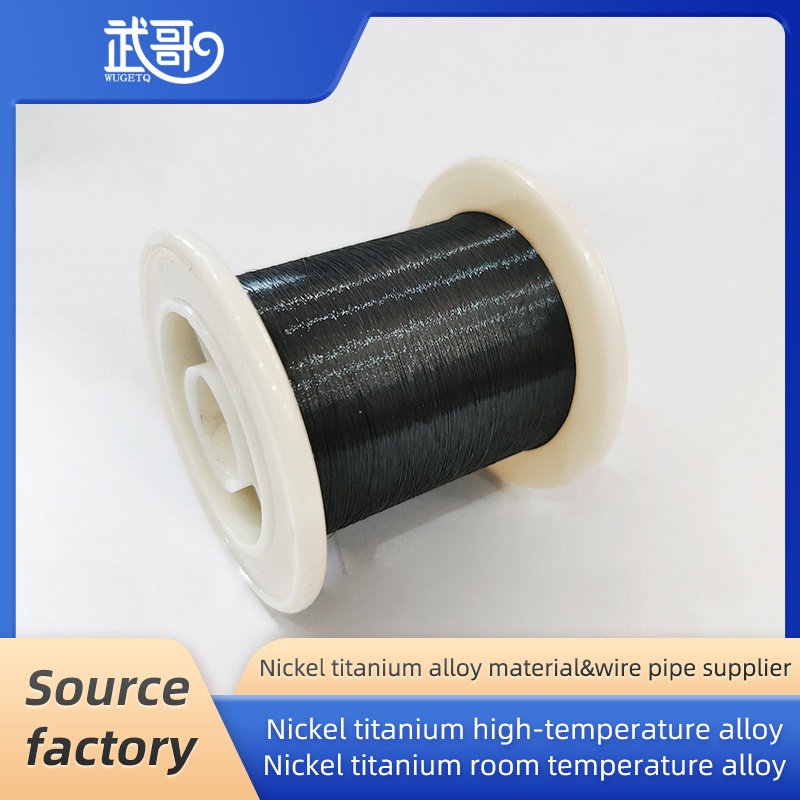
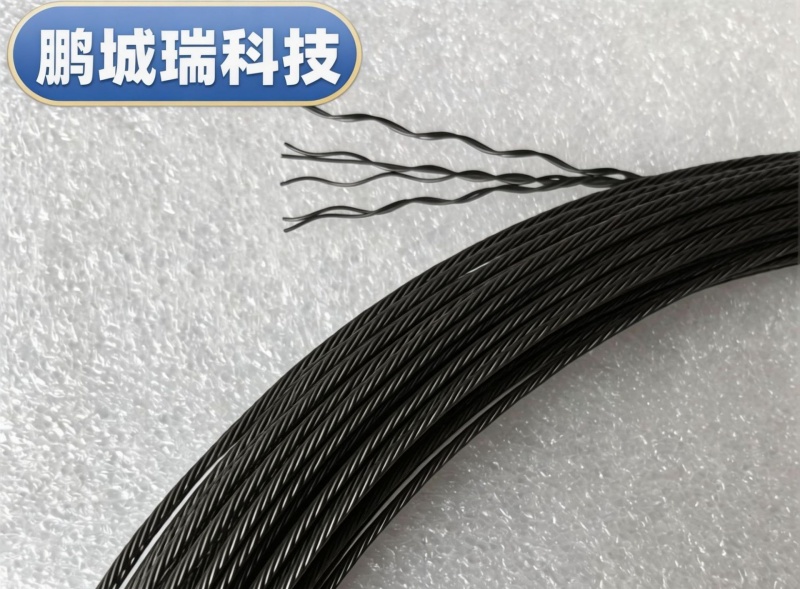
Nickel-titanium rope
III. Braiding and Forming: Twisting/braiding multiple strands of monofilaments into a rope
Based on the structural requirements of the nickel-titanium rope (such as the number of strands, twist direction, and braiding density), different braiding processes are selected:
1. Twisting process (applicable to flexible ropes)
- A twisting machine is used to twist multiple strands of nickel-titanium monofilaments according to the set twist direction (left twist/right twist) and twist pitch, forming a twisted rope. The common structure is 7 strands (1 core + 6 outer layers) or 19 strands.
During the twisting process, it is necessary to control the tension evenly to prevent uneven stress on individual filaments, which could lead to breakage or loosening of the rope.
2. Weaving process (applicable to high-strength ropes)
- Using a braiding machine (such as a circular braiding machine) to interlace multiple strands of monofilaments to form a braided rope, the braiding structure can be divided into plain weave, twill weave, or satin weave. It is characterized by high strength and good wear resistance, and is suitable for load-bearing scenarios.
IV. Heat treatment and sizing: imparting stability to the rope body
The core properties of nickel-titanium ropes (shape memory, superelasticity) are achieved through heat treatment for finalization, which is the most crucial step:
1. Sizing heat treatment
Fix the braided rope onto the shaping mold (maintaining the target shape, such as a straight line or a specific curved arc), place it in a vacuum furnace and heat it to 400~550℃, maintain the temperature for 30~120 minutes, and then cool it down with the furnace or air cooling.
- Too low temperature: unable to eliminate braiding stress, resulting in poor elasticity of the rope body;
- Excessive temperature: Coarse alloy grains, decreased strength, and shifted phase transition temperature.
2. Debugging of phase transition temperature
According to application requirements, by adjusting the heat treatment temperature and holding time, the austenite transformation temperature (Af) of the alloy can be precisely controlled to ensure that the nickel-titanium wire exhibits superelasticity or shape memory effect within the target temperature range.
V. Post-processing: Improving surface quality and performance
1. Acid pickling and polishing
To remove the oxide layer and oil stains on the surface of the rope body after heat treatment, a commonly used acid pickling solution is a mixture of nitric acid and hydrofluoric acid. After acid pickling, rinse with clean water, and then perform electrolytic polishing to enhance the surface finish and reduce the friction coefficient.
2. Performance testing
Conduct mechanical property tests (tensile strength, elastic modulus, elongation at break), phase transition temperature tests (differential scanning calorimeter DSC), and fatigue performance tests on the finished rope to ensure compliance with applicable standards.
3. Packaging and storage
The finished nickel-titanium rope needs to be sealed and packaged, stored in a dry environment, and protected from oxidation and corrosion.
Key process control points
1. Composition control: The deviation in the atomic ratio of nickel to titanium must be ≤±0.1%, otherwise it will significantly affect the phase transition temperature;
2. Drawing tension: During cold drawing, the tension of individual wires must be uniform to prevent diameter fluctuations;
3. Heat treatment atmosphere: It must be conducted in a vacuum or inert gas environment to prevent alloy oxidation;
4. Precision of the sizing mold: It directly determines the shape stability of the nickel-titanium wire.
The impact of application scenarios on processes
- Medical field (such as minimally invasive surgical guidewire): requires ultra-fine monofilament (0.1~0.3mm), high surface finish, and high braiding density;
- Industrial fields (such as mechanical sealing ropes and shockproof ropes): require thick monofilaments with high strength, and a higher heat treatment temperature to enhance wear resistance.
Nitinol
Seamless nickel titanium tube Nickel titanium fiber wire Nickel titanium plateApplication Area
Medical Industry New Energy Aerospace Machinery Manufacturing Marine Engineering Petrochemical IndustryContact Us
Contacts:Manager Wu +86 13632667260


 WeChat
 Call me
X